Submersible Well Pump Repair
A submersible pump lives at the bottom of your well, sometimes hundreds of feet down. We find out what is wrong from the surface first, pull the pump only when the tests say so, and fix the real problem instead of guessing.
What submersible well pump repair involves
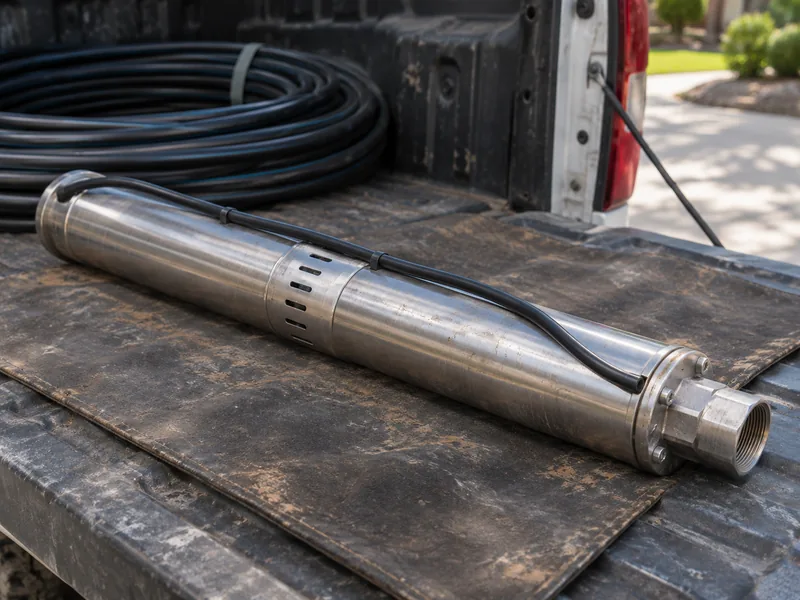
Most drilled wells built since the 1970s use a submersible pump: a long, narrow motor and pump assembly hung on pipe deep in the well casing, below the water. Because it pushes water up rather than pulling it, a submersible can lift water from hundreds of feet and lasts longer than most above-ground pumps, typically 10 to 15 years and sometimes much more.
When one fails, the hard part is that you cannot see it. A careless contractor pulls the pump first and asks questions later, which costs you a few hundred dollars in labor even when the pump turns out to be fine. We start with electrical tests at the surface: motor winding resistance, insulation resistance to ground, running amps, and voltage under load. These tests tell us whether the problem is the motor, the wire, the controls or the water supply before anything comes out of the well.
If the pump does need to come up, we use a powered pump hoist to lift it without kinking the pipe or damaging the casing. Once it is out, we inspect the pump end, the motor, the splice, the drop pipe, the torque arrestor and the check valves. Sometimes the repair is a new wire splice or a section of pipe; sometimes it is time for a replacement pump, and we show you why.
Signs your submersible pump needs attention
- Low or falling pressureWorn impellers or a hole in the drop pipe can drop output long before the pump stops.
- Pump runs constantlyA pump that never shuts off is either worn, leaking back down the well, or pulling from a falling water level.
- Tripping breakerOften a failing motor or damaged wire insulation, which surface tests can confirm.
- Sand or grit in the waterWorn screens or a pump set too low in the well. Sand wears impellers quickly.
- Higher electric billA worn pump runs longer to do the same work. A jump in the bill is often the first sign.
- Short cyclingUsually a tank or switch problem, but it wears out submersible motors fast if left alone.
What our submersible service includes
A trained technician does the work and talks you through it. You get the price in writing before anything is replaced.
Surface diagnostics
Ohm and megohm tests on the motor and wire, amp draw, voltage drop and control box checks.
Pressure and flow check
We measure how much water the pump delivers at your pressure setting and compare it to the pump curve.
Safe pump pull
Hydraulic or powered pump hoist, pipe clamps and a clean work area at the well head.
Component inspection
Pump end, motor, splice, drop pipe, safety rope, torque arrestor and check valves.
Targeted repair
Wire splices, pipe sections, check valves and pitless adapter seals replaced as needed.
Disinfection after work
The well is chlorinated after any pull to remove bacteria introduced by handling.
Two-wire versus three-wire pumps
Submersible pumps come in two common designs. A two-wire pump has its start components built into the motor, so there is no control box in the house. A three-wire pump has a control box near the pressure switch with a start capacitor and relay.
With a three-wire pump, many failures are in the control box, which is a cheap and easy fix at the surface. With a two-wire pump, the same failure is inside the motor, and the pump must come up. Knowing which you have changes the diagnosis and the likely cost, so we check that first.
Some newer homes have a constant pressure system with a variable-speed drive instead of a pressure switch. Those drives log fault codes that tell us a lot, such as underload (dry well), overload or a ground fault, before we touch a wrench.
How a submersible well pump repair visit works
The same four steps on every job, from a quick switch swap to a 600-foot pump pull.
Call or book online
Describe the symptoms. We triage on the phone and load the truck with the parts they point to.
Test before touching
We check voltage, amps, motor resistance, tank charge and flow, and tell you what we find.
Price in writing
You get the diagnosis and a fixed price before we start. If you want to think it over, that is fine.
Fix, flush and verify
Repair completed, well disinfected after any pull, and the system cycled until pressure is steady.
Questions about submersible well pump repair
How long does a submersible well pump last?
Most last 10 to 15 years. Pumps in sandy wells, with a waterlogged tank, or that short cycle often fail sooner. Pumps in clean wells with a good tank can last 20 years or more.
Can a submersible pump be repaired or does it have to be replaced?
The motor and pump end are usually replaced rather than rebuilt at the home level, but many problems are not the pump at all: wire, splices, pipe, check valves and controls can all be repaired.
How do you know the pump is bad without pulling it?
Motor winding resistance, insulation resistance and amp draw measured at the surface tell us whether the motor and wire are healthy. Flow and pressure tests show whether the pump end is worn.
How deep can you pull a pump?
Our hoists handle pumps at typical residential depths, including deep wells of 600 to 800 feet. Very deep or large agricultural pumps may need a pump rig.
Why chlorinate the well after a repair?
Pulling a pump exposes the inside of the well to hands, tools and air. A shock chlorination after the work kills any bacteria introduced during the job.
Related work
One worn part often wears out the next. These jobs tend to come up alongside submersible well pump repair.
Well Pump Replacement
Worn-out pumps replaced with a correctly sized submersible or jet pump, wire and fittings.
Learn moreDeep Well Pump Replacement
High-head pumps for wells from 300 to 1,000 feet, installed with the right hoist and wire.
Learn moreControl Box & Wiring Repair
Start capacitors, relays, overloads and well wiring tested and repaired.
Learn moreCheck & Foot Valve Replacement
Leaking check valves and foot valves replaced to stop water hammer and pressure loss.
Learn moreSubmersible Well Pump Repair near you
Need submersible well pump repair?
Tell us what the pump is doing. We will give you a likely cause, a price range and an arrival window on the first call.