Pressure Tank Replacement
Your pressure tank stores water under pressure so the pump does not start every time you open a faucet. When it fails, the pump short cycles and wears out fast. We replace it with a tank sized to give your pump long, healthy run times.
What pressure tank replacement involves
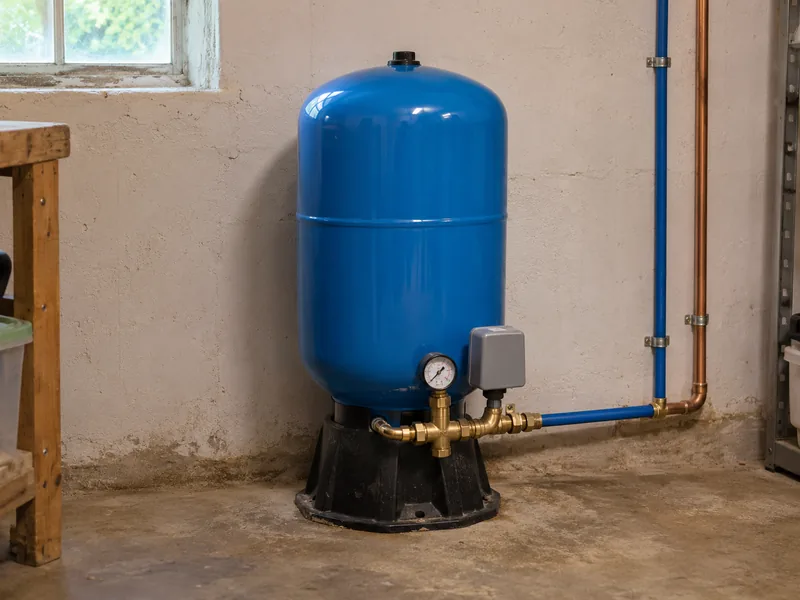
Modern well systems use bladder or diaphragm pressure tanks: a steel tank with a rubber bladder inside. Air above the bladder is compressed as water enters, and that air pushes water out to the house. When the bladder ruptures or the air leaks away, the tank waterlogs, holds almost no water, and the pump cycles on and off rapidly.
Tank sizing is about drawdown, the gallons the tank delivers between pump starts. A tank that is too small makes even a healthy system cycle too often. We size the tank so your pump runs at least a minute or two each cycle.
A replacement includes a new tank tee with gauge, relief valve and drain, a fresh look at the pressure switch, and the air charge set correctly.
Signs your pressure tank has failed
- Pump short cyclesClicking on and off every few seconds.
- Water from the air valveA ruptured bladder.
- Tank sounds full when tappedNo air cushion at the top.
- Rust or leaksCorroded steel tank shell.
- Fluctuating pressurePressure swings quickly during use.
- Old galvanized tankOlder tanks without bladders waterlog often.
What our tank replacement includes
A trained technician does the work and talks you through it. You get the price in writing before anything is replaced.
Tank sizing
Sized from pump flow and minimum run time.
New tank
Quality bladder or diaphragm tank.
Tank tee assembly
New gauge, relief valve, drain and unions.
Switch check
Pressure switch tested or replaced.
Air charge set
Pre-charge set 2 PSI below cut-in.
Old tank removal
Old tank drained and hauled away.
How big should my pressure tank be?
A common rule is one gallon of drawdown per gallon per minute of pump flow. A 10 GPM pump would need about 10 gallons of drawdown, which might mean a 40 to 50 gallon tank depending on the pressure setting.
Constant pressure systems need much smaller tanks. We size the tank for the system you have.
How a pressure tank replacement visit works
The same four steps on every job, from a quick switch swap to a 600-foot pump pull.
Call or book online
Describe the symptoms. We triage on the phone and load the truck with the parts they point to.
Test before touching
We check voltage, amps, motor resistance, tank charge and flow, and tell you what we find.
Price in writing
You get the diagnosis and a fixed price before we start. If you want to think it over, that is fine.
Fix, flush and verify
Repair completed, well disinfected after any pull, and the system cycled until pressure is steady.
Questions about pressure tank replacement
How long do pressure tanks last?
Most bladder tanks last 7 to 15 years, longer with good water and correct air charge.
How much does a pressure tank cost to replace?
Most replacements cost $700 to $2,500, depending on size.
Can a waterlogged tank be fixed?
Older non-bladder tanks can be drained and recharged. Bladder tanks with a ruptured bladder must be replaced.
Should I get a bigger tank?
A bigger tank reduces cycling and can extend pump life, if space allows.
What air pressure should my tank have?
About 2 PSI below the pump's cut-in pressure, measured with the tank empty.
Related work
One worn part often wears out the next. These jobs tend to come up alongside pressure tank replacement.
Pressure Tank Repair & Recharge
Air charge restored, fittings and gauges fixed, and tanks tested before you buy new.
Learn moreShort Cycling Repair
Pump clicking on and off every few seconds? We stop the cycling before it kills the motor.
Learn morePressure Switch Replacement
Burned, pitted or chattering pressure switches replaced and set correctly.
Learn moreConstant Pressure Systems
Variable-speed pump drives that deliver steady, city-like pressure from any well.
Learn morePressure Tank Replacement near you
Need pressure tank replacement?
Tell us what the pump is doing. We will give you a likely cause, a price range and an arrival window on the first call.