Pressure Tank Repair and Air Recharge
Not every tank problem means a new tank. Many just need the air charge restored, a leaking fitting replaced or a bad gauge swapped. We test the tank first and only recommend a new one if it has truly failed.
What pressure tank repair & recharge involves
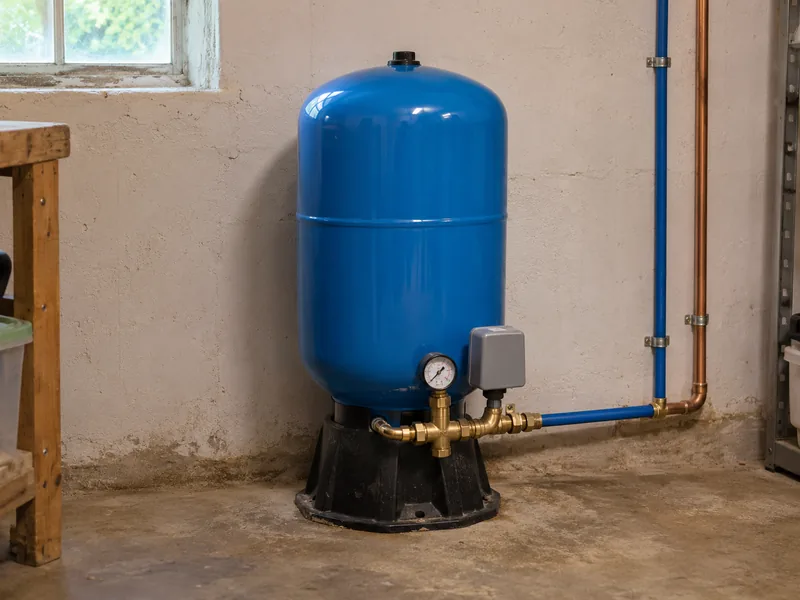
Pressure tanks lose a little air over time, even with a healthy bladder. When the air charge drops, the tank holds less water and the pump cycles more. A simple recharge often restores normal operation.
We drain the tank, check the pre-charge with an accurate gauge, test the bladder for leaks, and recharge to 2 PSI below your cut-in pressure. We also check the tank tee, gauge, relief valve and fittings for leaks or blockages.
If water comes out of the air valve, or the tank will not hold a charge, the bladder has failed, and we explain replacement options.
Signs your tank needs service
- Pump cycles more than beforeAir charge has dropped.
- Gauge reads wrongGauge stuck or damaged.
- Leak at the tank teeWorn fittings or unions.
- Relief valve drippingValve worn or pressure too high.
- Old air-over-water tankNeeds regular air recharging.
- Air spurting from faucetsOld tank with an air volume control problem.
What our tank service includes
A trained technician does the work and talks you through it. You get the price in writing before anything is replaced.
Drain and test
Tank drained and pre-charge tested.
Bladder check
Air valve tested for water.
Air recharge
Pre-charge set correctly.
Fittings repaired
Leaking unions, nipples and valves replaced.
Gauge replacement
Accurate new pressure gauge.
Relief valve check
Tested and replaced if needed.
How to check your tank's air charge
Turn off power to the pump. Open a faucet to drain all pressure. Use a tire gauge on the tank's air valve. It should read about 2 PSI below the pump's cut-in pressure, for example 38 PSI for a 40/60 system.
If it is low, add air with a compressor. If water comes out of the valve, the bladder has failed.
How a pressure tank repair & recharge visit works
The same four steps on every job, from a quick switch swap to a 600-foot pump pull.
Call or book online
Describe the symptoms. We triage on the phone and load the truck with the parts they point to.
Test before touching
We check voltage, amps, motor resistance, tank charge and flow, and tell you what we find.
Price in writing
You get the diagnosis and a fixed price before we start. If you want to think it over, that is fine.
Fix, flush and verify
Repair completed, well disinfected after any pull, and the system cycled until pressure is steady.
Questions about pressure tank repair & recharge
How often should I check my tank air pressure?
Once or twice a year is a good habit.
Can I recharge my pressure tank myself?
Yes, with the pump off and the tank drained. Use a compressor and tire gauge.
Why does my tank keep losing air?
A leaking air valve or a slowly failing bladder.
Is a waterlogged tank dangerous?
Not directly, but it causes short cycling, which damages the pump.
When should I replace instead of repair?
When the bladder has failed, the tank is rusted or leaks, or it is undersized.
Related work
One worn part often wears out the next. These jobs tend to come up alongside pressure tank repair & recharge.
Pressure Tank Replacement
Waterlogged, leaking or undersized pressure tanks replaced and sized for long pump life.
Learn moreShort Cycling Repair
Pump clicking on and off every few seconds? We stop the cycling before it kills the motor.
Learn morePressure Switch Replacement
Burned, pitted or chattering pressure switches replaced and set correctly.
Learn moreLow Water Pressure Repair
Weak showers and slow faucets traced to the switch, tank, pump, filters or well.
Learn morePressure Tank Repair & Recharge near you
Need pressure tank repair & recharge?
Tell us what the pump is doing. We will give you a likely cause, a price range and an arrival window on the first call.