Emergency Well Pump Repair, Day or Night
When a well pump quits, a home has no water for drinking, cooking, flushing or showering. Our emergency line is answered around the clock, and trucks carry the pumps, switches, tanks and control boxes that solve most no-water calls in a single visit.
What emergency well pump repair involves
A dead well is not like a dripping faucet. Without the pump, nothing in the house works, and livestock and pets go without water too. That is why we treat no-water calls as emergencies and dispatch them ahead of routine work, including nights, weekends and holidays.
Most emergencies come down to a short list of causes: a tripped breaker or blown fuse, a burned pressure switch, a failed start capacitor in the control box, a waterlogged pressure tank that makes the pump cycle until it overheats, a broken pipe or split hose inside the well, or a pump motor that has finally worn out. A good technician works through these in order, from the cheapest fix to the most expensive.
We stock our trucks for that order. Pressure switches, capacitors, relays, control boxes, check valves and pressure tanks ride along on every call, and common submersible pumps in 1/2, 3/4, 1 and 1.5 horsepower sizes are carried or available the same day. If the pump itself has failed, we can often pull and replace it before dark.
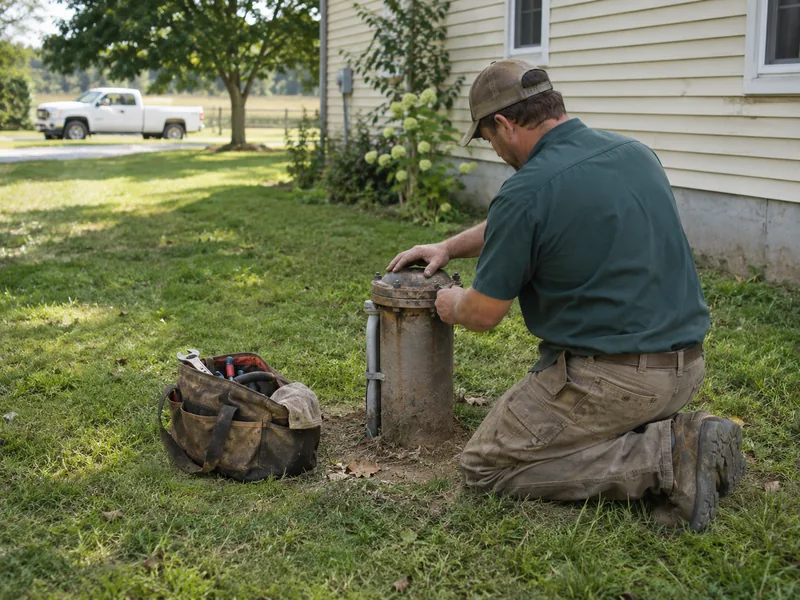
Call the emergency line if you notice
- No water from any faucetThe most common emergency. Check the well breaker once; if it trips again, stop and call.
- The breaker keeps trippingA short in the wire, a seized motor or a failed capacitor. Resetting it over and over can burn the motor.
- Pump runs but nothing comes outCould be a broken drop pipe, a lost prime on a jet pump, or a water level below the intake.
- Sputtering or air in the linesOften a falling water level or a hole in the drop pipe. Use as little water as possible until it is checked.
- Burning smell or a humming control boxTurn the pump off at the breaker. Electrical parts are failing and can damage the motor.
- Water on the floor around the tankA burst tank, split fitting or failed relief valve. Shut off the pump to stop the flooding.
What happens on an emergency call
A trained technician does the work and talks you through it. You get the price in writing before anything is replaced.
Phone triage
We ask a few quick questions so the technician arrives with the parts your symptoms point to.
Electrical check first
Voltage at the switch and control box, amp draw on the motor, and wire insulation tested with a megohmmeter.
Pressure system check
Pressure switch contacts, tank air charge, check valve and gauge, the parts that fail most often.
Pull the pump if needed
If tests point to the pump or drop pipe, we hoist it with a pump puller, inspect it and replace what failed.
Written price before work
You get the diagnosis and a price in writing before any repair. No surprise bills at 2 a.m.
Water back on and tested
We run the system through several cycles, check pressure settings and flush the lines before we leave.
What you can safely check before we arrive
Find the breaker for the well pump in your main panel. It is usually a double breaker labeled "well" or "pump". If it has tripped, reset it once. If it trips again right away, leave it off, because something is shorted and running it again can make the damage worse.
Look at the pressure gauge near the tank. If it reads zero and the pump is not running, the pressure switch may have failed or the system may have lost power. Do not tap or pry on the switch contacts; they carry 240 volts.
If you have water but it sputters, stop running irrigation, laundry and long showers. Sputtering often means the water level in the well is near the pump intake, and continuing to pump can run the motor dry.
How a emergency well pump repair visit works
The same four steps on every job, from a quick switch swap to a 600-foot pump pull.
Call or book online
Describe the symptoms. We triage on the phone and load the truck with the parts they point to.
Test before touching
We check voltage, amps, motor resistance, tank charge and flow, and tell you what we find.
Price in writing
You get the diagnosis and a fixed price before we start. If you want to think it over, that is fine.
Fix, flush and verify
Repair completed, well disinfected after any pull, and the system cycled until pressure is steady.
Questions about emergency well pump repair
How fast can you get to me for a no-water emergency?
Most emergency calls are reached within a few hours, depending on how far the property is from the nearest technician. We tell you an honest arrival window when you call.
Is emergency service more expensive?
After-hours visits carry a higher diagnostic fee than daytime appointments. Parts and repair labor are priced the same, and you approve the price in writing before work starts.
Can you replace the pump the same night?
Often, yes. We carry common submersible and jet pumps, pressure tanks and controls. Very deep wells or unusual pump sizes may need a second visit the next morning.
Should I keep resetting the breaker?
No. Reset it once. If it trips again, leave it off. Repeated resets on a shorted motor or wire can turn a $300 repair into a full pump replacement.
What should I do for water until you arrive?
Fill containers from a neighbor or buy bottled water, and keep a few buckets for flushing toilets. Avoid running anything that depends on the well.
Related work
One worn part often wears out the next. These jobs tend to come up alongside emergency well pump repair.
Well Pump Not Working
A step-by-step diagnosis of why the well pump will not turn on, shut off or deliver water.
Learn moreSubmersible Well Pump Repair
Testing, pulling and repairing submersible pumps from shallow wells to 800 feet deep.
Learn morePressure Switch Replacement
Burned, pitted or chattering pressure switches replaced and set correctly.
Learn moreWell Pump Replacement
Worn-out pumps replaced with a correctly sized submersible or jet pump, wire and fittings.
Learn moreEmergency Well Pump Repair near you
Need emergency well pump repair?
Tell us what the pump is doing. We will give you a likely cause, a price range and an arrival window on the first call.